Industry example · Interactive packaging
19 Crimes is not an EyeLoup client. This case study examines a notable industry example.
When the label
started talking.
How 19 Crimes turned an ordinary wine bottle into an interactive storytelling platform—and helped a distinctive brand become impossible to ignore.
5.5M
app downloads
22M+
AR activations
40%
case-volume growth, 2017–19
2.2M
cases sold by 2020
Hundreds of bottles.
One reason to stop.
Wine shoppers face hundreds of similar-looking products, often with little information to help them decide. 19 Crimes needed to capture attention at the point of purchase, tell its story, and create an experience people would remember and share.
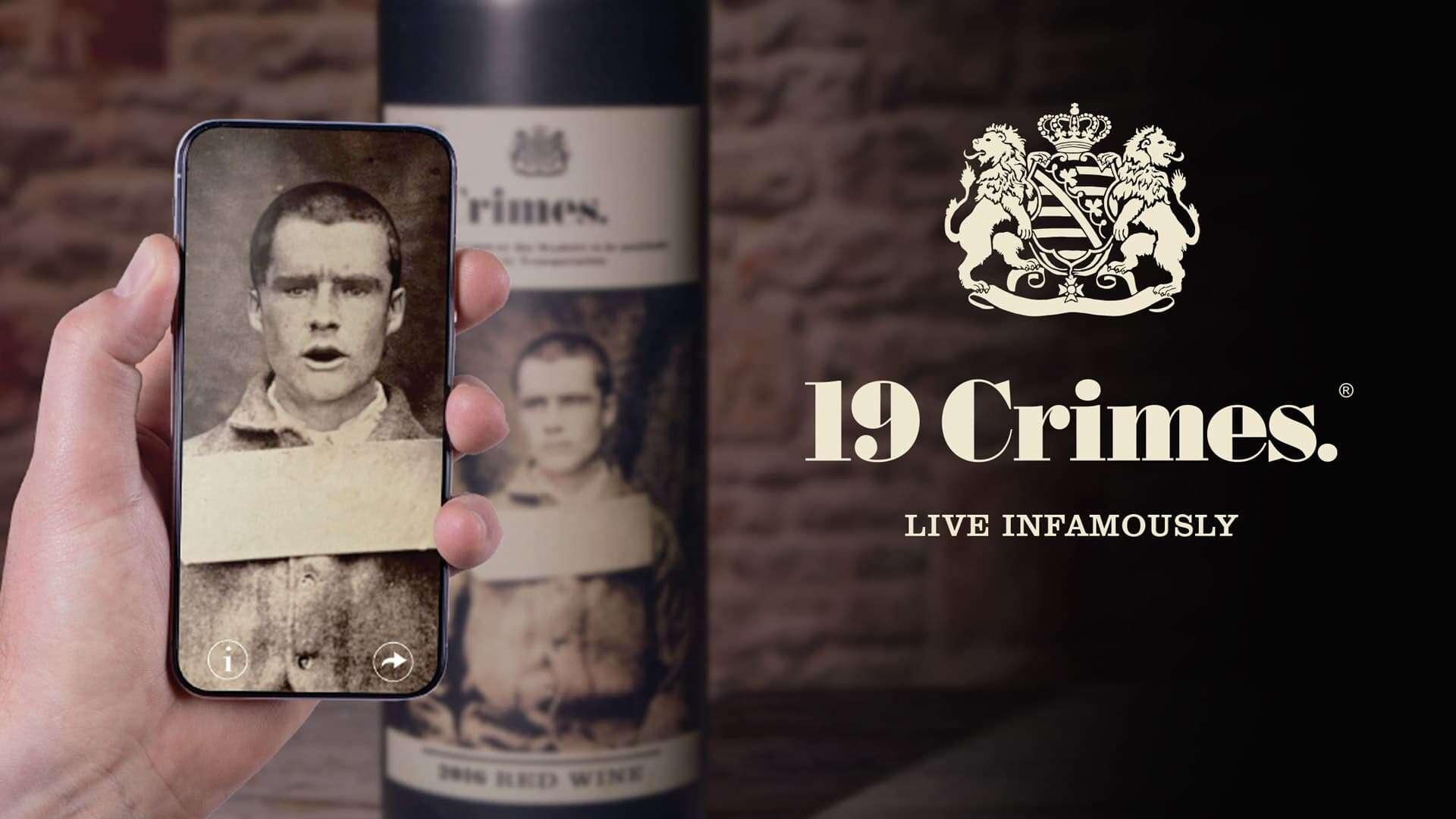
In 2017, the brand introduced an augmented-reality experience built around the historical figures featured on its bottles. After scanning a label with a mobile device, customers could watch the portrait animate and hear the character tell their story.
The physical bottle became a gateway to a digital experience—combining packaging, history, entertainment and brand storytelling.
The idea connected directly to the brand’s identity: British prisoners transported to Australia after committing one of the “19 crimes” punishable by exile.
Why it worked
The technology served the story.
This was more than a novelty. Each interaction strengthened the central idea behind the brand.
01It captured attention at the shelf
The animated label gave shoppers an immediate reason to pick up the bottle and explore it in a visually crowded category.
02It made the story memorable
Instead of adding more copy to the packaging, 19 Crimes let its characters tell their stories directly.
03It encouraged organic sharing
The unexpected experience gave customers something to demonstrate at parties and share on social media.
04It supported retail conversations
Interactive packaging gave retailers a differentiated proposition and an experience that could hold attention in the wine aisle.
05It connected physical and digital
The bottle became a persistent digital touchpoint that could keep engaging customers after purchase.
Commercial impact
Engagement that moved with the business.
The campaign was associated with significant consumer engagement and commercial growth. Following the initial U.S. rollout, 19 Crimes grew to a 1.5-million-case brand, reached approximately 2.2 million cases sold by 2020, and recorded another 22% of brand growth in 2021.
Treasury Wine Estates described the initiative as one of its most successful marketing activations. Its early success led the company to expand augmented-reality experiences to other brands in its portfolio.
Key takeaway
Packaging can become a media channel.
When the experience is closely connected to the product’s identity, augmented reality can help a brand:
- Stand out at the point of purchase
- Explain its story more effectively
- Increase consumer engagement
- Generate organic social exposure
- Strengthen its value to retailers
- Support measurable sales growth
The campaign succeeded because the technology made the central idea behind the brand tangible—and gave people a compelling reason to interact.
What this means for brands
Your packaging already has an audience.
Help it start a conversation.
EyeLoup connects packaging and printed materials to immersive digital content—creating new opportunities for storytelling, engagement and conversion.
Explore what your product could becomeSources
- 1. Treasury Wine Estates, “TWE Drives Consumer Engagement to Wine Brands Through Innovative Use of AR Technology,” 2018
- 2. Treasury Wine Estates, Annual Report 2018
- 3. PTC/Vuforia, “19 Crimes Uses AR to Differentiate Their Brand”
- 4. Shanken News Daily, “The Growth of 19 Crimes,” 2022
- 5. Treasury Wine Estates, Annual Report 2023